Proudly serving Phoenix, Scottsdale, Mesa, Tempe, Chandler, Gilbert & surrounding areasCall or Text 24/7: 602-449-0493
Aerial drone view of a suburban neighborhood with terra-cotta roofs and desert landscaping in Phoenix, AZ.

Landscape Planting: Shade Trees, Native Shrubs, and Desert Succulent Installation in Phoenix, AZ

Phoenix Expert Landscaping provides planting services across Phoenix and the surrounding Valley for residential yards, new construction landscapes, and commercial properties. Our crews install shade and fruit trees, shrubs and hedges, seasonal flowers, native Arizona plants, cactus, and succulents. We prepare each site with proper root-ball work, amended backfill, and drip irrigation tied to an existing system or a newly designed zone. Species are selected for the property's sun exposure, soil drainage, and Phoenix's USDA hardiness zone.

Phoenix's caliche-heavy soil, summer surface temperatures that regularly top 110 degrees, and intense monsoon downpours can overwhelm poorly matched plants. We break through hardpan when needed, plan for drainage, and set crowns slightly above grade to prevent pooling. Mature size and water demand guide spacing and hydrozone placement. Request a free planting quote, and we'll walk the property before recommending what to install.

Landscape maintenance, weed control, trimming, yard cleanup, and irrigation repair are available to support planted areas after installation.

Phoenix Expert Landscaping provides planting services throughout Phoenix and the surrounding metro, including Scottsdale, Tempe, Mesa, Glendale, and Chandler.

★ ★ ★ ★ ★4.9/5 Average Rating · 20+ Years of Experience · Thousands of Customers Helped · Licensed & Insured · Residential & Commercial

Phoenix Planting Options & Benefits

What Do Professional Planting Services Include?

Professional planting begins with the property: sun exposure, reflected heat, drainage, existing irrigation, utility lines, and the mature size of each species. We use those conditions to recommend trees, shrubs, flowers, cactus, succulents, or mixed beds that suit the site.

Installation includes proper root-ball preparation, caliche break-up when required, and amended backfill blended with compost. Crowns are set slightly above grade so water does not collect against trunks or stems.

Each new planting is connected to drip irrigation through an existing zone or a new line designed for the bed. If emitters or a mainline are failing, irrigation repair comes before planting so water reaches the new root zone reliably.

Benefits of Climate-Smart Planting

A planting plan built for Phoenix conditions improves establishment while reducing avoidable water waste and corrective maintenance.

  • Species matched to Phoenix heat, hardiness zone, sun, and drainage
  • Caliche preparation that gives roots room to expand
  • Mature-size spacing that reduces corrective pruning five years later
  • Drip irrigation placed for the new root zone
  • Hydrozone grouping that keeps water demands compatible
  • Native and desert-adapted choices that need less supplemental irrigation once established
  • Rock, decomposed granite, or mulch selected for the plant palette
  • Establishment care coordinated with landscape maintenance and weed control
Phoenix Planting Services

Planting Services for Phoenix Properties

From individual specimens to complete landscape beds, our planting work covers trees, shrubs, hedges, cactus, succulents, flowers, perennials, and relocated plants. Each service is coordinated with soil preparation, irrigation, and the property's existing hardscape.

Tree Planting Services

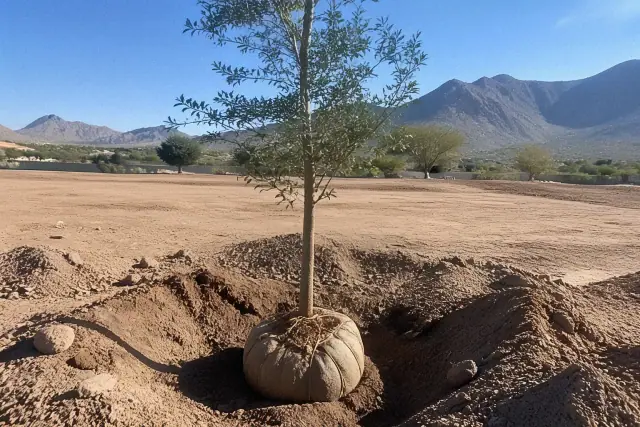
A newly planted sapling with exposed burlap root ball in a barren dirt plot in Phoenix, AZ.

We plant shade trees, fruit trees, flowering ornamentals, evergreens, and deciduous varieties with heat tolerance, root behavior, water demand, and clearance from foundations, walls, and pool decks in mind.

Request Estimate

Shrub and Hedge Planting

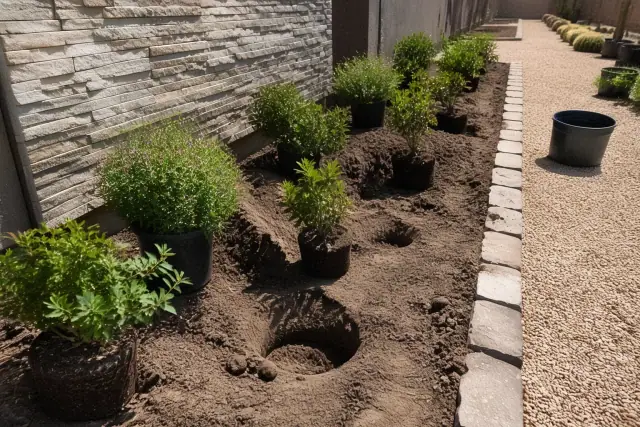
Partially dug holes with root balls for shrub and hedge planting in a Phoenix, AZ garden planter bed.

Shrubs provide structure, foundation color, and privacy screening. We select and space heat-tolerant plants for the site's microclimate and mature width, including dense evergreen hedges designed to close canopy within one to two growing seasons without crowding fences or walkways.

Request Estimate

Cactus and Succulent Planting

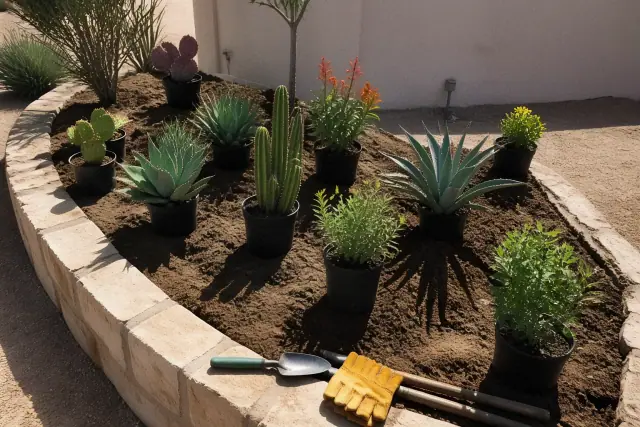
Cactus and succulent plants arranged in nursery pots on a soil bed for planting in Phoenix, AZ.

Cactus and succulents are oriented to match their prior sun exposure, set in well-draining backfill, and kept dry for one to two weeks after planting so cut roots can callous before irrigation resumes.

Request Estimate

Flower and Perennial Planting

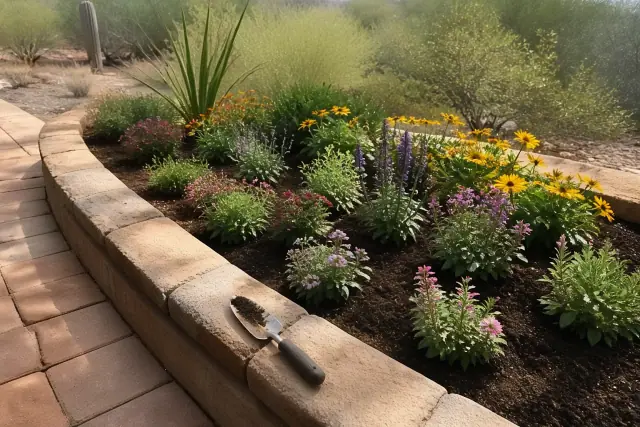
New flower and perennial plantings in a garden bed with a trowel on stone edging at a residential home in Phoenix, AZ.

Seasonal beds follow Phoenix's planting calendar: cool-season annuals go in during fall, heat-tolerant flowers carry summer color, and perennials such as angelita daisy, red bird of paradise, and penstemon return with less replanting.

Request Estimate

Garden and Landscape Bed Installation

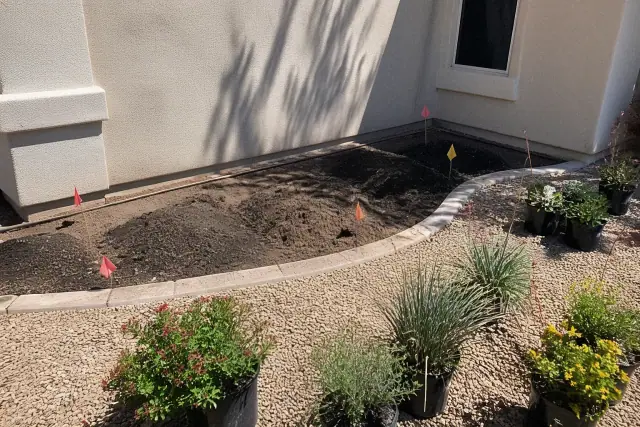
A garden bed with soil amendments and plant containers ready for landscaping in Phoenix, AZ.

Complete bed installation coordinates planting with grading, edging, irrigation valves, utility lines, and a surface finish. We handle front-yard renovations, backyard planting overhauls, and new construction landscapes starting from bare dirt.

Request Estimate

Tree and Shrub Transplanting

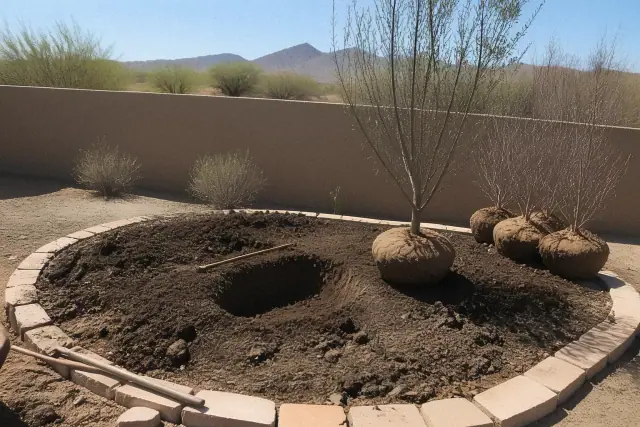
Newly dug holes and burlap-wrapped root balls in a garden bed ready for transplanting in Phoenix, AZ.

For trees and shrubs already on the property, we size the root ball to the trunk caliper, limit root disturbance, and replant immediately to reduce transplant shock. Large specimens may also need guy-wire staking and a berm-style watering basin during establishment.

Request Estimate
Planting Options

Plant Palettes for Phoenix Landscapes

The right palette depends on whether the goal is shade, edible fruit, privacy, seasonal color, low-water structure, or a complete bed renovation. We combine species and finishes around each property's heat, exposure, drainage, irrigation, and maintenance goals.

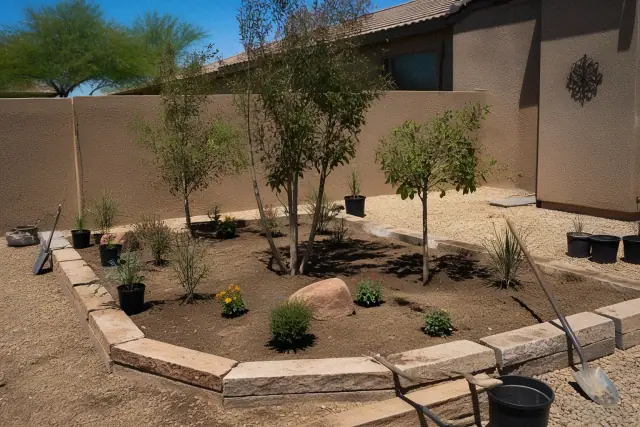
Newly planted trees and flowers in a stone-edged garden bed with crushed granite in Phoenix, AZ.

Trees for Shade, Fruit, and Seasonal Color

Tree selection balances summer heat tolerance, root behavior near foundations and hardscape, water demand, and the amount of canopy or color the yard needs.

  • Desert Willow for a heat-tolerant landscape accent
  • Palo Verde, including thornless Desert Museum Palo Verde with vivid yellow spring blooms
  • Chilean Mesquite, Texas Ebony, and Sissoo as Valley-performing choices
  • Citrus trees suited to mild winters with protection from occasional frost pockets
  • Small flowering and ornamental trees for courtyards and tight side yards
Request Estimate
Prepared soil bed with stone edging, tools, and desert gravel in Phoenix, AZ ready for native plant installation.

Native Arizona and Desert-Adapted Plantings

Native Arizona and desert-adapted plants support water-wise landscapes, consistent with the Arizona Department of Water Resources focus on regionally appropriate plant selection.

  • Palo Verde adapted to Valley rainfall patterns and alkaline soil
  • Brittlebush for desert character and low-water planting areas
  • Desert marigold for native color in sun-loving beds
  • Cactus and succulents installed with well-draining backfill
  • Hydrozones that separate higher-water accents from drought-tolerant plants
Request Estimate
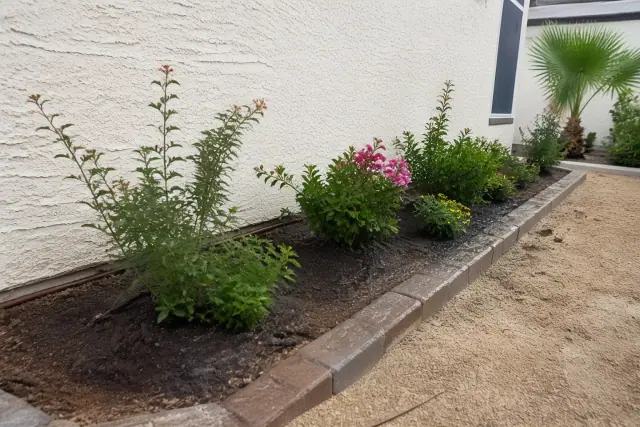
Heat-tolerant shrubs and hedges newly planted in a residential garden bed in Phoenix, AZ.

Heat-Tolerant Shrubs and Hedges

Shrubs and hedges can provide structure, screening, and warm-season color when their mature width and tolerance for reflected heat are built into the layout.

  • Texas sage for Phoenix heat and reflected sun
  • Oleander for shrub structure in reflected heat
  • Ruellia for hot areas near block walls and pavement
  • Yellow bells, or Esperanza, for heavy warm-season blooms
  • Lantana for direct afternoon sun near south- and west-facing walls
Request Estimate
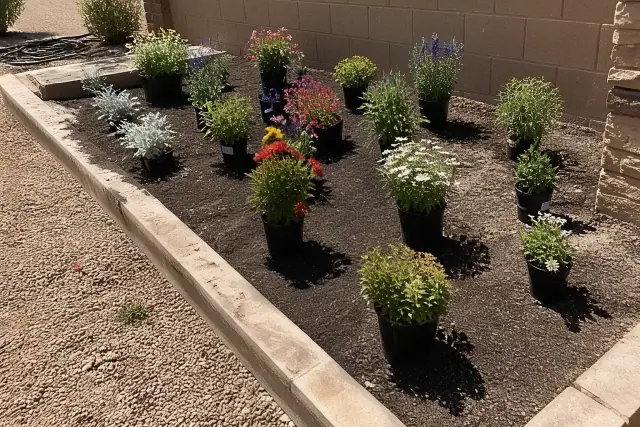
Seasonal flowers and perennials in nursery pots ready for planting in a garden bed in Phoenix, AZ.

Seasonal Flowers and Perennials

Phoenix flower beds shift with the seasons, using cool-season annuals through winter and spring and heat-tolerant color during the harshest summer months.

  • Petunias, marigolds, and snapdragons planted in fall
  • Vinca and portulaca selected to handle July and August heat
  • Angelita daisy for returning perennial color
  • Red bird of paradise for a warm-climate perennial accent
  • Penstemon for seasonal color with minimal replanting
Request Estimate
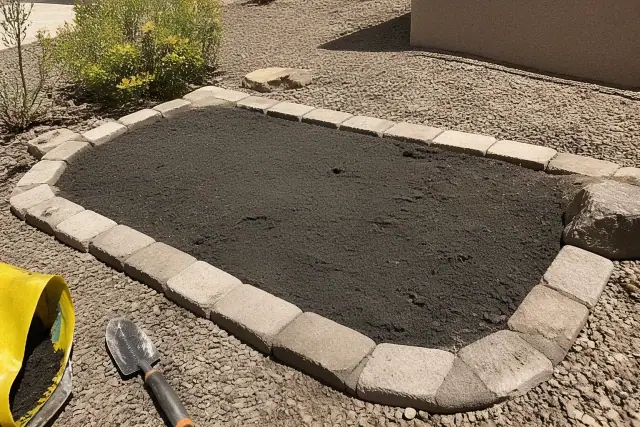
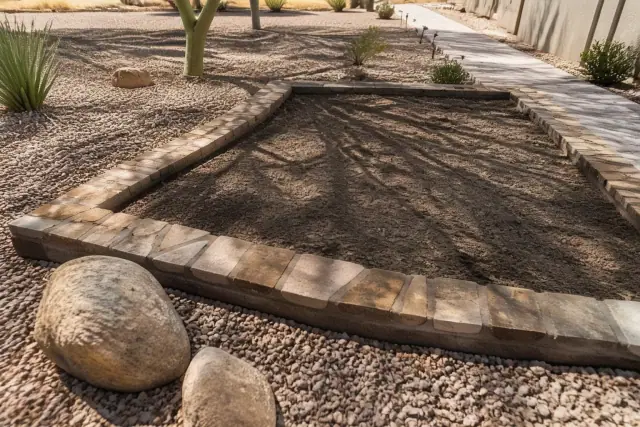
Empty stone-edged garden planter bed with desert rock mulch in Phoenix, AZ.

Garden Beds and Surface Finishes

A complete bed project coordinates plant placement with irrigation, grading, edging, focal points, and a groundcover suited to the selected plants.

  • Front-yard planting renovations planned around existing hardscape
  • Backyard planting overhauls layered around patios and focal points
  • New construction landscapes planned from bare dirt
  • Decomposed granite, rock, or gravel for desert-adapted beds
  • Organic mulch for ornamentals that benefit from greater moisture retention
Request Estimate
Match Plants to the Property

Choosing the Right Planting Approach

A south- or west-facing wall, shaded courtyard, open commercial frontage, and poolside bed can each create a different microclimate. We match the plant palette and irrigation zone to those conditions, then account for mature size so roots, canopies, and hedges fit the available space.

Climate-Responsive Plant Selection

Recommendations are based on Phoenix heat, the property's USDA hardiness zone, sun exposure, soil drainage, water demand, and the plant's mature spread rather than a generic species list.

Caliche and Drainage Preparation

When cemented caliche hardpan blocks the root zone, we break through it as needed and use amended backfill with compost. Plant height and drainage are checked before the hole is closed.

Irrigation and Establishment Planning

New plants are connected to a working drip zone, then irrigation runtimes and stress are monitored through the first one to two growing seasons. Deep, infrequent watering helps established roots grow downward while weed control keeps new beds clear.

What Sets Our Planting Work Apart

Why Choose Us for Phoenix Planting Services?

Phoenix Expert Landscaping coordinates plant choice, soil preparation, spacing, drip irrigation, and establishment care as one project. That approach keeps the planting plan grounded in the property's actual heat, drainage, access, and maintenance needs.

Request a Free Planting Quote

Caliche-Blocked Root Growth

Caliche is a cemented calcium carbonate layer that can stop roots and trap water when it remains intact beneath a planting hole. Breaking the hardpan where needed gives the prepared root zone a usable path into surrounding soil.

Heat and Transplant Shock

New roots are vulnerable when transplant shock and peak summer heat arrive together. Fall and late winter are preferred planting windows, while peak-summer installations are limited to exceptionally heat-hardy species with closely managed irrigation.

Water Pooling and Poor Drainage

Unbroken caliche or a crown set too low can leave irrigation water against the trunk or stem. We evaluate drainage and set the crown slightly above grade to reduce pooling at the plant base.

Crowding from Nursery-Pot Spacing

Spacing plants by nursery-pot size can crowd walkways, fences, and neighboring plants as they mature. We lay out trees, shrubs, hedges, and accents by mature spread to limit repeated corrective pruning.

Failing Emitters or Cracked Mainlines

A planting cannot establish if cracked mainlines or failing emitters leave the root zone dry. We address irrigation repairs before installation and connect each plant to an existing zone or a new line.

Sun Exposure Mismatch

Plants suited to a shaded courtyard may scorch beside a south- or west-facing wall, while sun-loving species can struggle in a north-facing exposure. Species placement follows direct sun, reflected heat, and available shade across the property.

How Planting Works

Our Phoenix Planting Process

The process moves from site conditions to plant selection, soil preparation, installation, irrigation, and establishment care. Each step is adjusted for the property rather than pulled from a one-size-fits-all plant list.

01.

Walk the Property

We walk the residential yard, new construction site, or commercial property to review sun, reflected heat, drainage, access, utility lines, existing irrigation, and the goals for shade, privacy, color, or renovation.

02.

Select the Plant Palette

Trees, shrubs, flowers, cactus, and succulents are selected for heat tolerance, root behavior, water demand, hardiness zone, mature spread, and the site's microclimate.

03.

Prepare Soil and Caliche

We open the root zone, break through caliche hardpan with a jackhammer attachment when needed, and prepare amended backfill blended with compost so roots are not confined by cemented soil.

04.

Set, Space, and Backfill

Root balls are prepared, plants are spaced by mature size, and crowns are set slightly above grade. Backfill and bed layout are finished around existing hardscape and the selected groundcover.

05.

Connect Drip Irrigation

Each plant is connected to drip irrigation through a sound existing zone or a new line. Failing emitters and cracked mainlines are repaired before the new planting depends on them.

06.

Support Establishment

Irrigation runtimes are adjusted as roots establish, and planted areas are monitored for stress. Deep, infrequent watering, landscape maintenance, and weed control help the bed settle in without excessive water or labor.

Plan Your Planting Project

Plan Your Phoenix
Planting
Project

Tell us what you want to add, replace, or relocate. Phoenix Expert Landscaping will walk the property, review soil, sun, drainage, and irrigation, then prepare a free planting quote based on the recommended scope.

Phoenix Planting Help

Phoenix Planting Services FAQs

Use these answers to compare planting timing, plant choices, installation details, and establishment needs for Phoenix properties.

Call About Planting Services

It depends on the season and the property's microclimate. Fall generally favors native and desert-adapted trees, cool-season annuals such as petunias and snapdragons, and perennials such as penstemon and angelita daisy. Spring can work for heat-tolerant shrubs and warm-season color such as lantana and vinca. We review sun exposure and irrigation before recommending a plant list.

Desert Museum Palo Verde is a frequently recommended low-maintenance choice for Phoenix properties. It has a thornless canopy, vivid yellow spring blooms, tolerates reflected heat, and needs little supplemental irrigation once established. It can serve as either a shade tree or an ornamental accent.

Garden planting generally begins in early fall, from late September through November, for cool-season vegetables, flowers, and many trees and shrubs. A second window opens from January into February for warm-season preparation. Summer choices are limited to exceptionally heat-hardy species because new roots face triple-digit afternoons.

October through November is the strongest tree-planting window because roots can establish during the cooler months before summer heat. January through February is the second-best option. Peak-summer installation is generally avoided unless the species is exceptionally heat-tolerant and irrigation can be managed closely.

Phoenix is in USDA Plant Hardiness Zone 9b, with some areas bordering Zone 10a. Winter lows rarely fall below 25 to 30 degrees Fahrenheit, allowing many subtropical and desert-adapted species to grow here.

In the Phoenix market, tree planting typically runs $3,114 to $4,475, with a wider range of $1,068 to $8,055 depending on tree size, root-ball weight, and site access. Broader landscaping projects average around $2,600 and range from $320 to $20,000 depending on scope. A property walk and quote are needed for the actual planting plan.

Planting holes are dug two to three times the width of the root ball. If cemented caliche hardpan blocks the root zone, it is broken with a jackhammer attachment when needed, then the hole is backfilled with amended soil blended with compost. Drainage is checked because intact caliche can trap water around new roots.

Every new planting is connected to drip irrigation, either through an existing zone or a new line designed for the planting. Failing emitters or a cracked mainline should be repaired before installation so water reaches the root zone consistently.

Cactus are oriented to match their prior sun exposure, which helps prevent sunscald, and both cactus and succulents are set in well-draining backfill. Irrigation is held for one to two weeks after planting so cut roots can callous before watering resumes.

Newly planted trees and shrubs need adjusted irrigation and stress monitoring through the first one to two growing seasons. Large specimen trees may require guy-wire staking for the first year and can take one to three years to establish before staking is fully removed. Deep, infrequent watering helps roots grow downward as they settle in.

Some established trees and shrubs can be moved on the same property. The root ball is sized to the trunk caliper, root disturbance is minimized during the dig, and the plant is replanted immediately to reduce transplant shock before roots dry out.

Yes. Phoenix Expert Landscaping performs planting work for residential yards, commercial properties, and new construction landscapes across the Phoenix metro. Plant placement is planned around access, irrigation valves, utility lines, sun patterns, and existing hardscape.

We compare direct sun, reflected heat, soil drainage, and the available irrigation zone. Sun-loving and desert-adapted plants fit exposed areas, while shade-tolerant choices are reserved for courtyards and north-facing spaces with less reflected heat. Plants are then grouped by water demand so each hydrozone can run appropriately.